How to humanize AI content without losing your actual voice
Learn the difference between AI-generated and AI-assisted content, why generic AI writing hurts trust, and how to use a Company Brain to make AI content sound human.
Chris Iglesia
Co-Founder, Truly Authentic Marketing
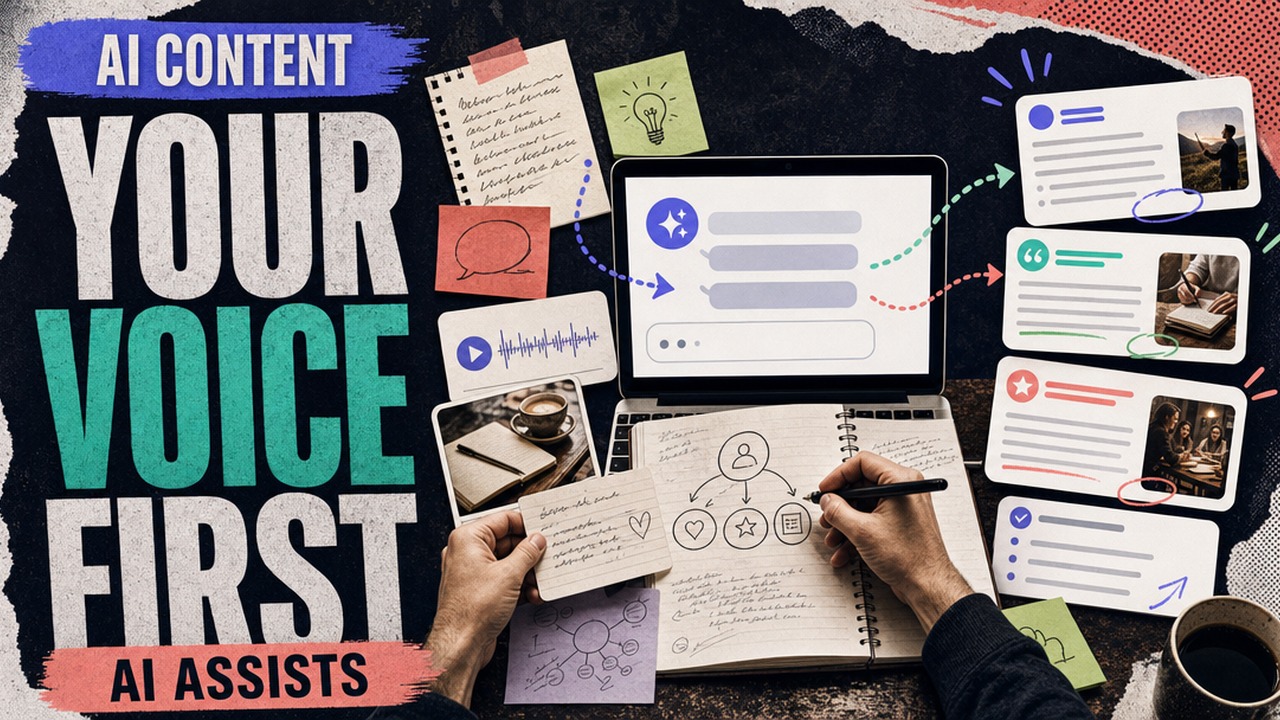
Here's the thing I keep seeing with AI content.
Most business owners don't have a "make it sound human" problem.
They have a source material problem.
They open ChatGPT, type something like, "Write me a blog post about AI for marketing," and then wonder why the draft sounds like every other blog post on the internet.
And honestly, that makes sense.
If you give AI the same thin prompt everyone else gives it, you're going to get the same average answer everyone else gets. Cleaner grammar, sure. Maybe a nicer structure. But still average.
That is the part most people miss.
The goal is not to hide that AI helped you write. The goal is to make sure the human is still the source.
Your ideas. Your buyer. Your examples. Your way of explaining the problem. The stuff you say on client calls when you're not trying to sound impressive, you're just trying to help somebody finally get it.
That is the difference between AI-generated content and AI-assisted content.
What does "humanize AI content" actually mean?
Humanizing AI content means turning a draft into something that sounds like a real person with a real point of view wrote it.
Some of that is editing. Sentence rhythm matters. Word choice matters. Reading it out loud helps a lot because your ear will catch what your eyes let slide.
Microsoft's guidance on natural AI writing says a lot of the same practical things: vary the sentence structure, match the tone to the audience, replace vague language, and read the copy out loud so you can hear where it gets stiff.
That is useful.
But that is only the surface layer.
The deeper layer is context.
Human content carries context. It has memory inside it. It has the client's objection you have heard 20 times. It has the weird analogy you use because, for some reason, that one always makes the light bulb go on. It has the sentence you say on a call when somebody is overwhelmed and you need to slow the whole thing down.
AI can't create that from nothing.
It can help you organize it. It can help you sharpen it. It can help you turn it into something clear enough for the right person to understand.
But it needs something real to work with first.
What is AI-generated content?
AI-generated content is what happens when the machine does most of the thinking from a thin prompt.
Example:
"Write me a blog post about how to use AI for marketing."
The AI can do that. It will probably create something that looks fine at first glance.
It may talk about efficiency, personalization, workflows, automation, customer engagement, and content creation. None of those points are automatically wrong.
The problem is that none of them prove the AI understands your business.
It doesn't know your buyer. It doesn't know your offer. It doesn't know what your clients are scared of. It doesn't know which objections keep showing up on sales calls. It doesn't know what you refuse to say because it sounds fake coming out of your mouth.
So it writes from the average of what it has seen.
And average is exactly where a business goes to disappear.
What is AI-assisted content?
AI-assisted content starts in a different place.
The human stays in the driver's seat.
You bring the idea. You bring the story. You bring the client language. You bring the framework. You bring the proof you can actually stand behind. You bring the gut check that says, "Yeah, no, I would never say it like that."
Then AI helps you move faster.
OpenAI describes writers using ChatGPT as a sounding board, story consultant, research assistant, and editor. That is the frame I like better. Not "replace the writer." Not "go make me sound like every other AI blog."
More like: help me think this through, find the cleaner structure, catch the weak spots, and pull the better version of my own point onto the page.
That is AI-assisted.
It's not outsourcing your brain.
It's giving your brain a better operator.
Why does AI-generated content usually sound generic?
AI-generated content usually sounds generic because the input is generic.
A prompt like "write a blog post about AI marketing" gives the model almost nothing to work with. No audience tension. No buyer language. No real example. No specific offer. No lived experience. No point you are trying to help the reader finally understand.
So the model reaches for common patterns:
- "In today's fast-paced digital landscape..."
- "AI is transforming the way businesses..."
- "Unlock the power of..."
- "Streamline your workflow..."
- "Let's dive in..."
That kind of writing is not evil.
It's just empty.
And empty content costs more than people think.
It costs attention. It costs trust. It costs authority. It makes the reader feel like they already read the article before, because they basically have.
Is AI-generated content bad for SEO?
AI content is not automatically bad for SEO.
Google has said its systems aim to reward original, high-quality, people-first content that shows experience, expertise, authoritativeness, and trust, no matter how the content was produced.
But Google also says using automation, including AI, mainly to manipulate rankings violates its spam policies.
That is the line I want business owners to pay attention to.
If AI helps you create something useful, accurate, and grounded in real expertise, you are in a much better place.
If AI is just cranking out pages that add no value, you are building on sand.
Google's guidance on generative AI content also says AI can help research a topic and add structure to original content. But generating a lot of pages without adding value for users may violate scaled content abuse policies.
So the question is not, "Did AI touch this?"
The better question is, "Would this still help a real person if Google traffic disappeared tomorrow?"
If the answer is no, the content needs more human source material.
How do you make AI content sound human?
You make AI content sound human by putting human material into the system before you ask for the final draft.
Here is the simple version.
1. Start with the real thought.
Do not start with the prompt. Start with the thing you actually mean.
Record a voice memo. Dump the messy notes. Paste a sales call transcript. Pull the FAQ. Grab the objection your client keeps repeating. Use the line you say when you are explaining the point to a real person, not trying to impress an algorithm.
A messy ramble with a point of view will beat a polished prompt with no soul.
2. Give AI the room before you give it the task.
Most people ask AI to write before they tell it where it is.
That is backwards.
Before AI writes, it should understand:
- who you are talking to
- what they already believe
- what they are frustrated with
- what your offer actually does
- what your framework is
- what language your clients use
- what proof you can safely reference
- what you refuse to say
- what your voice sounds like when you are actually being yourself
That is why a Company Brain matters.
3. Use AI as an interviewer before you use it as a writer.
This is one of the cleanest ways to keep AI-assisted content human.
Instead of saying, "Write the article," say something closer to:
"Interview me about this idea. Ask one question at a time. Pull out my examples, my opinion, my story, my framework, and the thing I think most people are missing."
Now the AI is not replacing your thinking.
It is pulling your thinking out of you.
That is a completely different job.
4. Build the draft around your framework.
Generic AI drafts follow generic structures.
Better content follows your structure.
For TAM, that might mean looking at the topic through expertise, authority, trust, and client pull. For another business, it might be a diagnostic process, a service method, a teaching framework, or the way the founder explains the same problem on every discovery call.
Your framework is what makes the content yours.
5. Add lived proof and texture.
This does not mean fake case studies.
Please don't do that. Ever.
It means adding real texture:
- what you hear on sales calls
- what clients usually misunderstand
- the mistake people keep making
- the moment the idea finally clicked for you
- the reason you explain it differently now
- a safe, non-confidential example
If you do not have proof yet, mark the gap and come back to it.
Do not let AI invent proof because the paragraph feels lonely.
6. Do a voice pass.
This is where you remove the AI fingerprints.
Cut the filler. Remove the corporate words. Break the rhythm where it feels too neat. Replace vague lines with specific ones. Read it out loud.
If it sounds like a webinar host trying to sell "the future of innovation," pull it back.
If it sounds like you explaining a useful point to a smart business owner who is tired of fluff, you are getting closer.
What is the Company Brain method for AI-assisted content?
The Company Brain method is simple:
Your business keeps a living source of truth, then uses AI to create from that source instead of guessing from the open internet.
A useful Company Brain can include:
- brand voice
- offers
- frameworks
- sales call notes
- FAQs
- client objections
- approved proof points
- case studies
- testimonials
- internal processes
- content ideas
- founder rambles
- examples of what you would and would not say
This turns AI from a random content machine into a trained assistant.
For a business owner, that is the whole point.
You are not trying to create more content just to create more content. You are trying to turn what your business already knows into assets that build trust, answer objections, and help the right client understand why your approach makes sense.
AI-generated content says, "Here is a generic article about your topic."
AI-assisted content trained on your Company Brain says, "Here is your idea, shaped for your buyer, using your language, your framework, your proof, and your next step."
That difference matters.
How do you train AI on your voice and frameworks?
Start with five buckets.
Voice: Give it real examples of how you talk and write. Include the phrases you actually use, and the phrases you do not want showing up in your content.
Audience: Give it your dream client, their pains, their objections, the language they use, and what they are trying to achieve.
Offer: Give it what you sell, who it is for, what it includes, what it does not include, and what transformation it creates.
Frameworks: Give it your named methods, your steps, your diagnostic questions, and the way you teach the problem.
Proof: Give it only approved proof. Verified outcomes, safe stories, real screenshots, source links, or clear placeholders that say proof is needed.
Then give AI a job description.
For content, that job might be:
"You are my AI-assisted content strategist. You do not invent proof. You ask for missing context. You preserve my voice. You use my frameworks. You make the reader feel understood before you teach. You help me turn my raw thinking into useful, people-first content."
That one paragraph will beat 100 random "make this sound human" prompts.
What should you never let AI do?
Never let AI make up your authority.
Never let it invent proof.
Never let it decide your positioning without your input.
Never let it write in a voice you would be embarrassed to read out loud.
Never let it publish unverified facts.
Never confuse speed with strategy.
AI can help you move faster. I love that part.
But if it helps you move faster in the wrong direction, you just created more cleanup work with better grammar.
What is the real difference between AI-generated and AI-assisted content?
Here is the clean distinction.
AI-generated content starts with the machine.
AI-assisted content starts with the human.
AI-generated content asks, "Can this tool create something for me?"
AI-assisted content asks, "Can this tool help me express what I actually know more clearly?"
One optimizes for output.
The other optimizes for trust.
That is why the second one wins for serious businesses.
The broader creative world is already wrestling with the same idea. The U.S. Copyright Office has said generative AI outputs can be protected by copyright only where a human author determines enough expressive elements, and that prompts alone are not enough. It also said using AI to assist the creative process does not automatically block copyrightability.
Different context. Same principle.
The human contribution matters.
What is the better way to use AI for content?
Use AI like a trained team member, not a vending machine.
Give it context. Give it boundaries. Give it your frameworks. Give it your rough thinking. Let it ask questions. Let it organize. Let it challenge weak logic. Let it find gaps. Let it help with structure, clarity, examples, titles, and repurposing.
Then you edit like a human who cares.
Because people can feel that.
They can feel when content came from a real point of view. They can also feel when it came from a prompt trying to sound important.
Your business does not need more content that sounds like everyone else.
It needs content that makes the right person think, "Oh, they get it."
That is how you build authority.
That is how you earn trust before the call.
That is how your expertise starts creating client pull instead of more noise.
Want to build an AI-assisted content system that still sounds like you?
If your business has real expertise but your content keeps coming out generic, the problem is probably not the AI tool.
The problem is that the tool has not been trained on your business yet.
Take the AI Strategy Quiz and we will help you see which part of your growth system needs to be built first: your Company Brain, your content system, your follow-up path, or your first AI Employee.