How to Use AI for Content Without Sounding Like Everyone Else, Being a Robot, or Losing Your Soul
Most AI content does not sound generic because AI is bad. It sounds generic because people give AI boring inputs, accept boring outputs, and then act shocked when the internet gets another beige LinkedIn smoothie. Here's how to use AI for content without losing your voice.
Truly Authentic Marketing
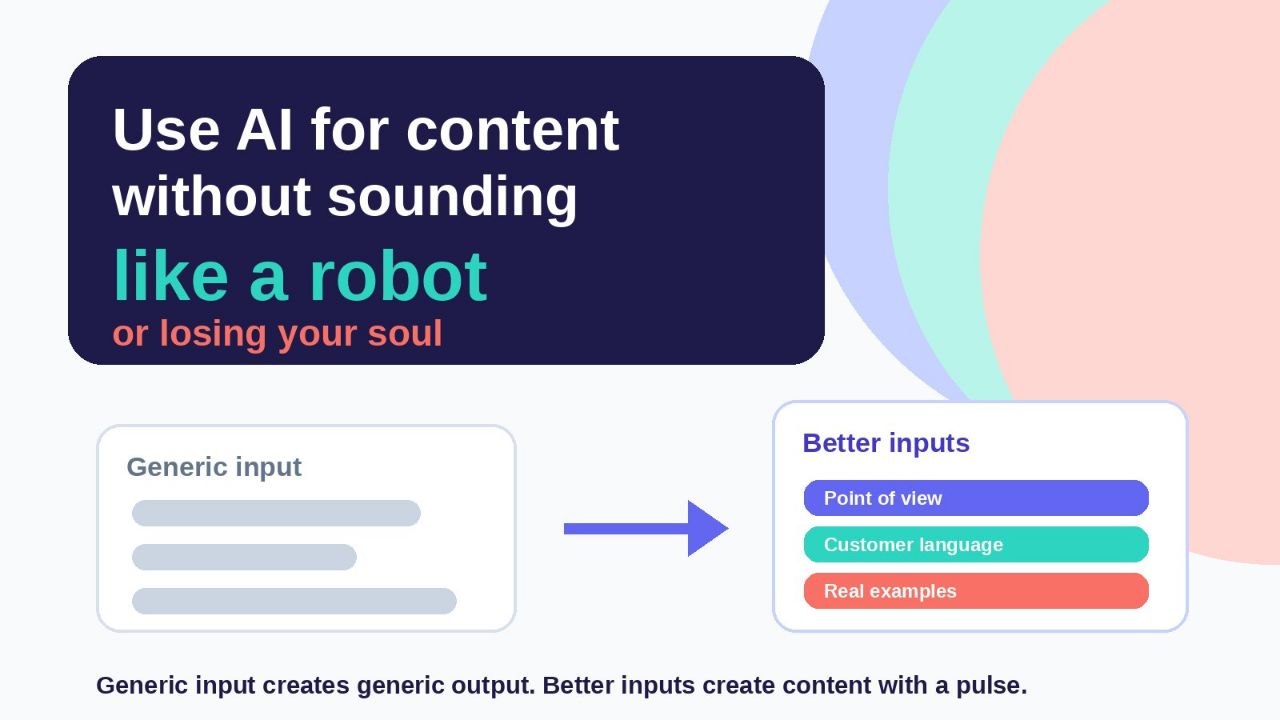
Most AI content does not sound generic because AI is bad. It sounds generic because people give AI boring inputs, accept boring outputs, and then act shocked when the internet gets another beige LinkedIn smoothie.
There. That is the whole problem in one sentence.
Everybody is using the same tools. Everybody is asking the same questions. Everybody is getting the same safe, polished, "technically fine" answer.
Then they paste it into the world and wonder why it sounds like a robot wearing a blazer.
The problem is not that AI cannot help with content.
It absolutely can.
The problem is that most people are asking AI to replace the part of the process that actually makes content worth reading: the opinion, the customer insight, the weird little human phrase, the story from a call, the thing you almost said out loud but softened because you thought it sounded too spicy.
That is usually the good stuff.
And that is exactly the stuff AI needs from you before it can help you create anything that sounds like you.
Why does AI content sound generic?
AI content sounds generic when the input is generic.
That sounds simple because it is. Annoyingly simple, actually.
If your prompt is:
"Write me a blog post about AI content."
AI will give you the average internet answer about AI content.
Not your answer.
Not your customer's answer.
Not the answer that came from ten sales calls, three frustrated voice notes, a weird shower thought, and that one comment that made you go, "Okay, that is what people are really worried about."
Just the average answer.
And average content is exactly what makes people scroll past while their brain quietly whispers, "I've seen this before."
Most people blame AI for that.
I don't.
I blame the empty prompt.
I blame the missing point of view.
I blame the fact that people ask AI to be creative before they have given it anything real to create from.
Is AI bad for content creation?
No. Bad inputs are bad for content creation.
AI can be ridiculously useful when you use it the right way.
It can help you organize a messy idea. It can help you find the strongest angle in a ramble. It can turn one thought into a blog outline, LinkedIn post, carousel, short-form script, email, and resource checklist.
That's not the enemy.
The enemy is treating AI like it is supposed to magically know your voice, your clients, your offer, your taste, your stories, your humor, your boundaries, and the specific way you would explain something if you were talking to a real person over coffee.
(And let's be honest, half the time over coffee is where the best version comes out.)
AI does not replace your point of view.
It needs your point of view.
It does not replace your taste.
It needs your taste.
It does not replace the lived experience of talking to customers, building the thing, selling the thing, fixing the thing, explaining the thing, and occasionally wondering why the thing was harder than it needed to be.
AI can help you move faster, but the signal still has to come from somewhere.
That somewhere is you.
How do I use AI for content without sounding robotic?
Start earlier in the process.
Most people use AI at the writing stage.
They open ChatGPT, Claude, Gemini, or whatever tool is currently being yelled about on the internet and ask it to write the finished thing.
That is backwards.
Use AI before the writing stage.
Use it to interview your thinking.
Use it to pull the strongest opinion out of your messy voice note.
Use it to find the tension between what your audience believes and what you know from experience.
Use it to organize customer language from calls, DMs, comments, emails, reviews, and support tickets.
Use it to ask, "What is the boring version of this idea, and what is the more useful version?"
That is where AI gets powerful.
Not as the voice.
As the thinking partner.
The writing gets better because the thinking got better first.
What should I give AI before asking it to write content?
Give it better raw material.
This is the part most people skip because it feels like work.
Bad news: it is work.
Good news: it is also the part that makes the content not stink.
Before you ask AI to write, give it these five inputs.
1. Give AI your actual opinion
AI needs a point of view to sharpen.
Bad input:
"Write a post about AI content."
Better input:
"My take is that AI content does not sound generic because AI is bad. It sounds generic because people use lazy inputs and publish the first draft. Help me turn that into a thought leadership article with a practical framework."
Now we have something.
There is tension. There is an opinion. There is a little bite.
Not fake controversy. Just a real stance.
Try starting with one of these:
- "Most people get this wrong because..."
- "The advice I disagree with is..."
- "The thing nobody says out loud is..."
- "My clients think the problem is X, but it is actually Y."
- "If I could fix one belief around this topic, it would be..."
That gives AI something human to build around.
2. Give AI a specific audience
"Business owners" is not specific enough.
Who are you really talking to?
A local service business owner who wants to post more but does not want to sound fake?
A coach with strong opinions who freezes when the blank page opens?
A small team trying to create more content without turning the brand into oatmeal?
The more specific the audience, the more specific the content.
If you tell AI to write for everyone, it will sound like it was written for nobody.
And nobody is not a great customer avatar. (Bold strategy, but probably not the move.)
3. Give AI customer language
This is one of the fastest ways to make AI content sound more human.
Do not just tell AI what you sell. Give it the words your audience already uses.
Pull from:
- Sales calls
- DMs
- Comments
- Reviews
- Support tickets
- Reddit threads
- YouTube comments
- Emails
- Client objections
- Meeting notes
If people say, "I want to use AI, but I don't want my content to sound like ChatGPT wrote it," use that.
If they say, "Everything sounds too polished and fake," use that.
If they say, "I feel like AI makes me sound like a corporate intern who drank three webinars," please use that immediately because that line has legs.
Customer language beats clever copy almost every time.
4. Give AI examples and stories
Generic content floats above real life.
Examples pull it back down.
You do not need a full case study every time. Small moments work:
- A question a client asked
- A mistake you keep seeing
- A before and after from your own workflow
- A common objection from a sales call
- A pattern you noticed in comments
- A post you saw that made you roll your eyes so hard you almost needed a chiropractor
The point is texture.
A generic article says:
"AI can help improve content creation."
A better article says:
"If your prompt is 'write me a post about AI marketing,' you are basically asking the internet blender to make you the same smoothie everyone else is drinking."
Same idea.
Very different pulse.
5. Give AI your standards
Most people accept AI's first draft too quickly.
That is where the robot voice sneaks in.
You need an editing standard.
Ask AI:
- "Where does this sound generic?"
- "What lines sound like they came from a marketing template?"
- "What would make this feel more like a real person wrote it?"
- "Which claims are vague?"
- "What sentence would make someone roll their eyes?"
- "Where am I saying the safe version instead of the useful version?"
AI can help you edit against your taste, but only if you tell it what your taste is.
Do not let the tool decide what your voice should be.
That is how you wake up one day and realize your content sounds like a terms-of-service page discovered personal development.
How can I make ChatGPT sound more like me?
Give it a brain before you give it a task.
This is where a Company Brain matters.
Not in a boring corporate wiki way. I mean a simple, useful, living place where your AI can understand:
- Who you serve
- What you sell
- What you believe
- What your customers ask
- What objections come up
- What your brand sounds like
- What examples are safe to use
- What calls to action actually exist
- What proof is real and what still needs to be earned
Without that context, AI is guessing.
With that context, AI has something to work from.
Does the Company Brain do the call to action during community? Not by itself.
But it can give your content system the raw material it needs so your posts, emails, articles, and follow-up do not start from a blank page every single time.
That is the bigger game.
Not "make me a post."
More like:
"Use our Company Brain, customer language, offer notes, brand voice, and this messy idea to help me create a useful piece of content that still sounds like me."
That is a much better relationship with AI.
What is a better AI content workflow?
Here is the simple version.
Step 1: Start with the messy thought
Record a voice note. Paste a rough rant. Drop in bullets from a meeting.
Do not clean it up too much.
The messy version usually has the good stuff in it: the frustration, the real language, the funny phrase, the almost-too-honest opinion, the reason the topic matters.
That is the material AI needs.
Step 2: Ask AI to find the strongest opinion
Prompt:
"Read this messy idea and tell me the strongest point of view inside it. What is the actual argument I am making?"
This finds the spine before you start writing.
Step 3: Ask AI to find the tension
Prompt:
"What does my audience currently believe, and what am I challenging? What is the tension?"
Good content has friction.
Not fake drama. Friction.
A belief being challenged. A mistake being corrected. A problem being named clearly.
Step 4: Add customer language
Give AI comments, questions, objections, sales call notes, support tickets, or DMs.
Prompt:
"Use these customer phrases to make this piece sound grounded in real conversations, not generic content advice."
This is where the soul starts coming back.
Step 5: Draft around the thesis
Now ask AI to write.
Now.
Not before.
Prompt:
"Write this as a thought leadership article with a practical how-to framework inside it. Keep the voice direct, warm, specific, slightly edgy, and human. Use italics for emphasis where it helps. Add a little humor. Avoid em dashes. Avoid generic AI phrases. Do not over-polish it."
Step 6: Run the anti-robot edit
After the draft, ask:
"What parts of this sound like AI wrote them? Be ruthless. Then rewrite those parts in a more human, direct voice."
The first draft is not the finish line.
It is clay.
(And sometimes the clay is wearing a nametag that says "In today's fast-paced digital landscape." We remove that nametag immediately.)
How do I keep my brand voice when using AI?
You keep your brand voice by staying in charge of the taste.
AI should scale your voice, not replace it.
Use it to sharpen your thinking. Use it to organize ideas. Use it to find angles. Use it to repurpose one idea across different platforms.
But do not hand it the keys to your personality.
Your content should still carry:
- Your customer conversations
- Your experience
- Your humor
- Your taste
- Your opinions
- Your weird little way of explaining things
That is what people connect with.
Not perfect grammar.
Not the fact that you used AI.
Not another polished paragraph that sounds like every other polished paragraph on the internet.
People connect with signal.
AI can amplify signal, but it cannot create it from nothing.
What should you stop doing with AI content?
Stop asking AI to create your point of view for you.
Stop publishing first drafts.
Stop using prompts that could apply to any business in any industry.
Stop asking for "professional" when what you really mean is clear, useful, and trustworthy.
Stop letting AI sand off the edges that make your content yours.
And please, for the love of all things human, stop opening content with:
"In today's fast-paced digital landscape..."
Nobody has ever read that sentence and thought, "Finally. This person understands my pain."
Nobody.
What should you do instead?
Use AI earlier in the process.
Use it to research.
Use it to interview your messy thinking.
Use it to find the tension.
Use it to organize raw ideas.
Use it to pull patterns from customer language.
Use it to create options.
Then use your judgment.
That is the part people skip.
AI is powerful, but it should not be the final authority on your voice.
It should be the assistant sitting next to you saying:
"Here are five ways to shape this. Which one actually sounds like you?"
That is a much better relationship.
And honestly, a lot less weird than letting the robot fully drive while you sit in the passenger seat wondering why your brand suddenly sounds like a software onboarding email.
How do you use AI without losing your soul?
You give it something real.
That is the move.
Real customer language.
Real opinions.
Real stories.
Real standards.
Real examples.
Real business context.
The future of content is not human versus AI.
It is generic input versus real input.
It is lazy prompting versus better thinking.
It is publishing whatever the machine gives you versus using the machine to sharpen what you actually mean.
If your AI content sounds generic, do not just blame AI.
Look at what you gave it.
Give it better raw material. Give it a stronger opinion. Give it customer language. Give it examples. Give it your standards.
Use AI to move faster, but do not hand it the keys to your voice.
That is how you use AI for content without sounding like everyone else, being a robot, or losing your soul.
Want the simple system behind this?
If you want to use AI for content without starting from a blank page every time, the first step is giving your AI better business context.
That is exactly why we built the AI Business Growth Academy and the Adaptive Company Brain approach.
Start here: Get your free AI Growth Plan