Do Local Businesses Still Need a Website?
Google Business Profile and social media matter, but they are not a replacement for a website you control. Here is what a local business site needs to do now, and the minimum viable version to start with.
Chris Iglesia
Co-Founder, Truly Authentic Marketing
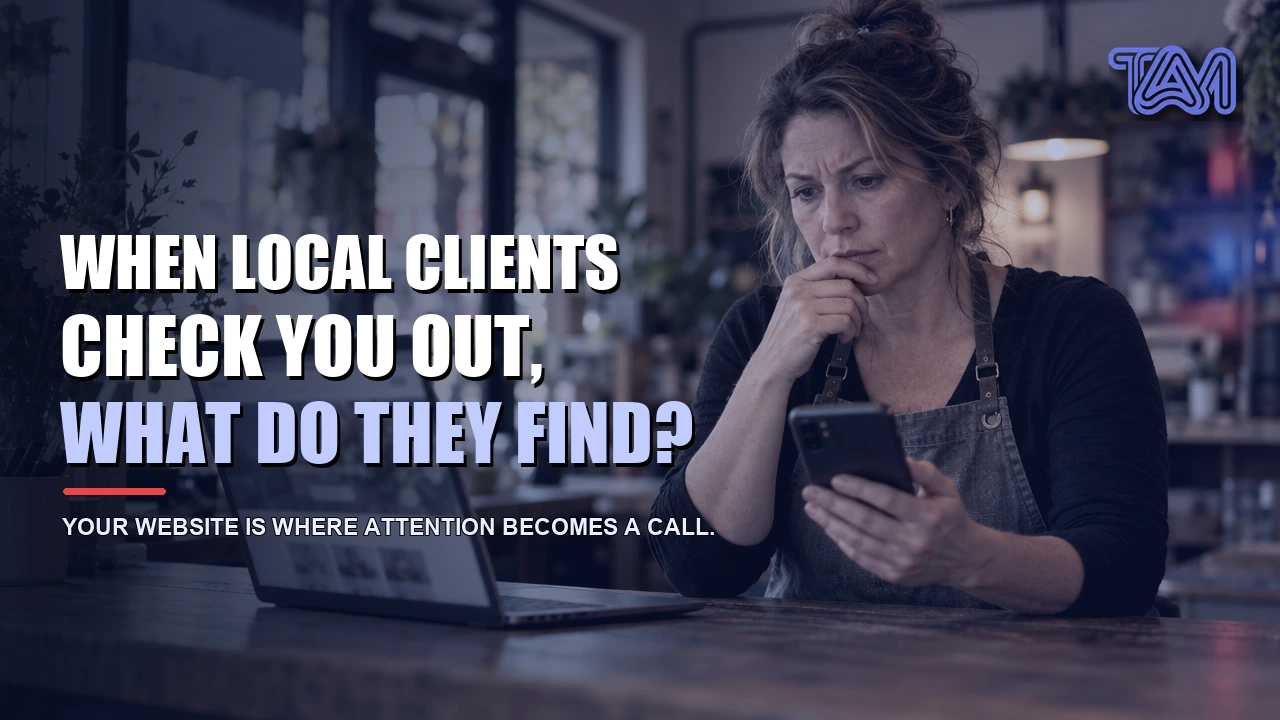
Quick answer: Do local businesses need a website? Yes, just not the brochure version. It is the one place you control where people can find you, trust you, and take the next step. Google Business Profile, social media, referrals, and ads all work better when they point there.
Why Your Website Is More Than a Brochure
A local business site used to be a digital calling card: name, logo, phone, and a team photo.
Chris's Field Note: Your public website is the front desk, not the private records room. It greets people, answers their questions, and points them to the next step.
Customers behave differently now. A homeowner reads service pages before requesting an estimate, and a business owner scans a services page at night with one problem in mind.
They want evidence that you understand their situation and a plain way to act. Give the website that job.
The site has three jobs:
- Easier to find, with pages in the words customers use
- Easier to trust, with real photos, credentials, and earned reviews
- Easier to buy from, with a clear next step: call, book, or quote
Those are the real benefits of having a website for a small business.
Put the outcome before the method. Lead with plain service language, keep the headline specific to the result, and save the how for later. Write like you would talk to a nervous first-time customer: confident and caring, never combative.
Where Google and Social Fit
Google Business Profile remains an important discovery point for local businesses. Google's Business Profile setup guide explains that eligible storefront and service-area businesses can manage how they appear on Search and Maps and add hours, website, phone, location, and social or booking links. Verified profiles can also show searches, views, calls, website clicks, and messages through Business Profile performance insights.
Here is what owners miss: a profile is a summary living inside someone else's system. It cannot walk a patient through a first visit or show a homeowner how you protect their floors. It points people somewhere. Your site is where they arrive.
Social media is strong for reach, but it runs on rules you do not set. Social creates discovery. Your website is where people evaluate the business and take the next step. That is why the website vs social media for small business debate misses the point: the channels do different jobs.
One Path From Click to Client
Picture the whole path:
- Discovery: search, social media, a referral, or an advertisement
- Evaluation: service pages, proof, answers, and your process
- Action: a call, booking, quote request, or registration
- Follow-up: the human and system that keep the conversation moving
This is why campaign traffic should converge on one destination you control. Landing pages can support an offer, but the registration, booking, or inquiry path should stay measurable. When campaigns scatter people across disconnected pages, measurement becomes harder and follow-up becomes easier to miss.
Think of the website as your always-on digital home. Campaign pages can connect to it, but the home base gives people one place to decide whether to call, book, or inquire.
Chris's Field Note: Publishing and prospecting do different jobs. Content builds trust when a prospect checks you out. Conversations and follow-up help create the path to a client. More posting cannot fix a missing handoff between attention, the site, the next step, and follow-up.
A Website That Becomes a Teammate
Most websites are treated as finished on launch day. I believe that is backwards: a modern site can stay editable and keep improving through a controlled update process.
An AI website employee can act as a controlled go-between, not a replacement for judgment. Request routine changes in plain language, and a human still oversees what goes live. The promise is easier operation with oversight, not unattended automation.
In a local-practice website project, we connected content to booking and CRM and built a controlled path for the client's AI employee to draft, audit, preview, and propose updates, with a person approving publication and every change reversible.
Chris's Field Note: Early on, AI could hand me a polished post that still felt wrong, and my honest reaction was, "This isn't us. This is not me." Voice samples teach the how. Knowledge, strategy, context, and guardrails teach what it should know and how to perform.
Some of your best website content is already sitting inside conversations you are having. Short expert conversations can become videos, FAQs, articles, and resources.
How Your Website Supports Search
Google explains that Search moves through crawling, indexing, and serving. It also says that crawling, indexing, and ranking are never guaranteed. Google Search Essentials recommends helpful, people-first content, buyer language in prominent places, and crawlable links.
A homepage can carry your main promise while local pages address city-level search intent. A page about one service, written for the towns you serve, gives people and search engines more useful context than a page titled "Services." Google's LocalBusiness structured-data guide explains how a site can provide details like hours and departments, which may support enhanced appearances without guaranteeing them.
Google's guidance for AI search says its generative features build on core Search systems and use crawlable, indexed web content. That covers Google's features, not every AI assistant. The preparation is familiar: publish clear pages about what you do, where you do it, and who you serve.
The Three-Question Test
Here is a test I used in a recent client session, adapted for websites. A visitor should be able to answer three questions within seconds:
- Is this for me?
- Can I trust this person?
- What should I do next?
Chris's Field Note: The three questions came out of a client session, where I used them to check whether a profile was ready to convert. If a stranger cannot answer all three in seconds, the page is doing too little.
Minimum Viable Website Checklist
One strong page can be a legitimate start. If you start there, make sure it covers:
- What you do, with each service in plain language
- Who you serve and where, including towns you cover
- Proof: licenses, credentials, years in business, photos of real work
- How pricing works, when you can share it
- Hours, location or service area, and phone
- A clear next step, repeated: call, book, or quote
- A quick phone test: page reads well, next step easy to tap
- Clean basics: descriptive title and heading, crawlable links, LocalBusiness structured data when ready
One strong page beats ten thin ones, and small things matter. A floating opt-in that covers your legal links is a usability and compliance problem, not a design quibble. Add pages later once they carry real information.
Frequently Asked Questions
Do I need a website if I already have a Google Business Profile?
Yes, and they work best as a pair. The profile helps people find and trust you on Search and Maps, then points them to your site. The profile is the doorway; the website is the room.
Can social media replace a website for a small business?
Sometimes social is where customers first meet you, but platforms set the rules and control who sees your posts. Social creates discovery; your website is where people decide what to do next.
Is a one-page website enough for a local business?
It can be a solid start. One page works when it answers core questions and makes the next step obvious on a phone. Expand later with more pages.
How much should a small-business website cost?
Any honest answer starts with scope. A single well-written page costs less than a multi-page site with booking. Compare the total cost across domain, hosting, and maintenance, and be skeptical of numbers quoted early.
How long does it take a new website to rank on Google?
No one can promise a timeline. Google does not guarantee crawling, indexing, or ranking, even for pages that follow its guidance. Treat the first months as foundation work.
One Clear Next Step
If this made you realize your site is still a brochure, or that you never built one, start small. One page that makes you easier to find, trust, and buy from can grow into much more.
Truly Authentic Marketing helps owner-led businesses turn what they already know into a client-attraction system, so the business gets easier to find, trust, and buy from. We call it the Gravity Engine, and it starts with one conversation about your expertise.
When you are ready, Plan My Gravity Engine.